 By
By You know the pattern. Money pours in during the busy months, then the work dries up and you spend the quiet stretch juggling bills, pushing out the overdraft and hoping nothing breaks. Then it picks up again and you’re too flat out to think about it.
That’s feast or famine business cash flow, and most owners treat it like the weather. Something that happens to you. Something to get through.
It isn’t weather. It’s a cost, and almost nobody has ever added it up what it costs your business.
So let’s add it up.
What Does a Feast or Famine Year Actually Cost?
Four things cost you money every time you go round this cycle. Some show up on a statement. The two biggest ones never do.
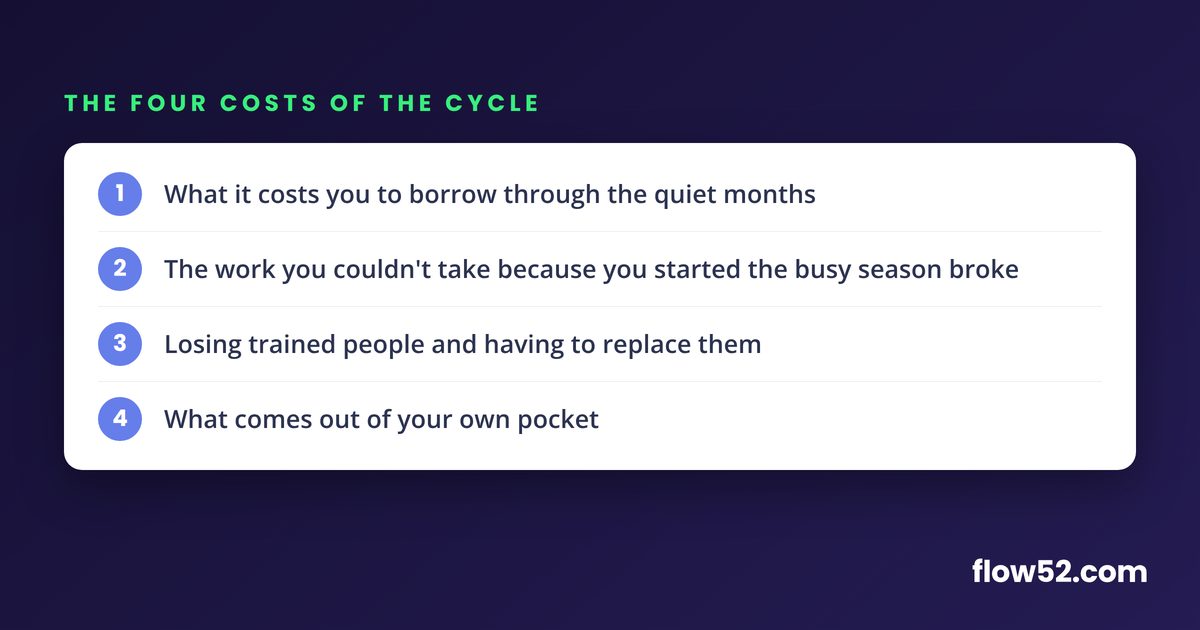
We’ll price each one, using one made-up business, and total it at the end.
But before we start, our example business does make enough money during the entire year to fund the quiet season and take a profit. It’s not the turnover that’s the problem. It’s knowing how to manage that cash so you don’t spend the money in the busy times because you think you are rolling in it.
About the numbers: they’re illustrative, for a small owner-operator business with one employee. Yours will be different. Use them for the concept, not the amounts.
The year splits into:
- 14 peak weeks
- 16 shoulder weeks
- 22 quiet weeks
Cost 1: What Borrowing Through the Quiet Season Costs
The quiet season arrives and the bills don’t stop. Rent, insurance, vehicle payments, your own household. So you reach for whatever’s available.
Our example business borrows 10,000 to get through, and pays back 1,000 in interest and fees across the year.
Four possible ways owners borrow to cover the gap
- Overdraft. You’re charged every day you have a negative balance, plus a fee just for having it available. Convenient, but the easiest one to still be paying for months later.
- Credit card. Fine for a few weeks. Past that it’s usually the dearest money you’ll ever borrow. It can also go on and on.
- Business loan or line of credit. Lower rate per month, but only a saving if you clear it. Most owners don’t clear it before the next quiet season comes round.
- An advance on credit/debit card takings. If your customers pay by card at the counter, a lender hands you a lump sum now and takes a set slice of every card payment, usually 10 to 25%, until it’s cleared.
What it costs to borrow 10,000 to get you through
Illustrative, and rates vary by lender and country. The order rarely changes.
| How you borrow it | You pay back | It costs you | Roughly, as a yearly rate |
|---|---|---|---|
| Overdraft | 11,000 | 1,000 | about 15% |
| Credit card | 11,400 | 1,400 | about 25% |
| Business loan | 10,550 | 550 | about 10% |
| Advance on card takings | 12,000 | 2,000 | about 45% |
The difference in costs to you depending on the borrowing method you use is 1,450. If you are going to borrow, its a decision you need to make carefully.
Whatever method you use, the cost of borrowing shows in your accounting so you actually see it. This is why owners think this cost is the worst of not having cash in the slow season. But it can often be the least expensive option compared to what does not show up in your accounting.
Cost 2: What an Underfunded Peak Costs
Here’s the one nobody counts.
Your busy season doesn’t start when the customers arrive. It starts a few weeks earlier, when you buy stock, pay deposits, fix the vehicle and get a second pair of hands lined up. All of it goes out before a single job gets paid.
If you start your pre-busy season with nothing in the bank then you can’t set yourself up for a great season. So you set up what you can afford now, which is often way less than what you really need to be really ready before the customers arrive.
Think of a market stall on the busiest day of the year with half the stock. The crowd still turns up. You just have nothing to sell them.
What that looks like in practice
- Turning down jobs because you can’t buy materials up front
- Running one crew member when the work would have supported two
- Keeping the tired vehicle going instead of fixing it, then losing days when it breaks down when it is most needed
- Skipping the advertising that fills your calendar, because it costs money now and pays later
Our example business had to turn away work worth about 20,000 in takings because he just didn’t have the cash to be fully organised. After materials and wages, the profit lost is 7,000.
This is the single most expensive part of the cycle, and it never appears on any statement, because you can’t invoice a job you didn’t take.
You can see it happen in one industry in our landscaping off-season guide, where the ramp-up spending lands weeks before the first payment does.
Cost 3: What Losing Staff and Rehiring Costs
Quiet season comes, you can’t cover the wages, so someone gets let go. It feels like the responsible call. It’s often the expensive one.
Replacing them costs you:
- Advertising the role
- Your own hours spent sorting through applicants and interviewing
- Six or so weeks where the new person is paid full rate and working at part speed
- Mistakes, callbacks and redone work while they learn your customers
For our example business that comes to 3,600, and that’s assuming it goes well and the first person you hire works out.
The part you can’t put a number on
“Good people don’t sit around waiting. They go to a competitor, and they take everything they knew about your customers with them. Sometimes they take a few of the customers too.”
You can always rehire. You can’t always rehire them.
Cost 4: What You Pay Personally
This one gets left off because it doesn’t feel like a business cost. It is.
- You skip your own wage for a week here, a week there.
- Your savings go in to cover a bill
- Your personal credit card covers something the business should have paid for
Call it 4,000 for our business, and that’s a modest year.
That money is gone the same as any other cost. The only difference is you’re the one who lent it, quietly, to a business that will need it again next year and never repay.
The Total, and Why It Repeats
| What it cost | Amount |
|---|---|
| Borrowing through the quiet season | 1,000 |
| Work you couldn’t fund | 7,000 |
| Losing staff and rehiring | 3,600 |
| Out of your own pocket | 4,000 |
| One year of feast or famine | 15,600 |
Now the part that matters most.
Every one of those costs makes next year’s quiet season harder to fund. You end the peak with less profit because you took fewer jobs. You’ve got a loan to clear. Your personal savings have been depleted. So you go into the next quiet stretch thinner than the last one, borrow a bit more, and come out the other side with even less to fund the following peak.
It’s a water tank you never quite refill. Every dry season starts a little lower, and each one is harder to get through than the last.
Feast or famine cash flow doesn’t stay the same price. It gets dearer every year you go round the cycle.
“And the next slow season cycle will just cost you more than the previous one.”
What Would It Have Cost to Be Ready?
Same business. Instead of borrowing through the quiet season, it puts money aside all year into a holding account. That’s a separate account that exists only to hold money to pay the yearly, quarterly or large monthly bills regardless of when they are due.
It needs 12,000 in there to cover the quiet season and the ramp-up into peak. Here’s what that takes weekly:
| Weekly amount | Weeks | Total | |
|---|---|---|---|
| Peak | 600 | 14 | 8,400 |
| Shoulder | 200 | 16 | 3,200 |
| Quiet | 20 | 22 | 440 |
| Put aside over the year | 52 | 12,040 |

Compare the two.
- One year of the cycle: 15,600, gone
- Planning for it: 12,040, still yours, just being managed
The second number isn’t even a cost. It’s your own money, sitting in your own account, waiting for bills you already knew were coming. You’re not poorer by 12,040. You’re 15,600 better off.
Notice the quiet-season figure. Twenty a week. Nobody’s asking you to save hard when there’s nothing coming in. The heavy lifting happens in the weeks when the money’s actually there.
The Hard Part is the Number, not the Idea
“Ask any owner whether they should put money aside for the quiet season and they’ll say yes. They’ve always known. What stops them is working out how much.”
You’d have to start with every large and irregular bill coming up in the year ahead. Rent, tax, insurance, registrations, the annual ones that always seem to need to be paid in the quiet season. Then work out roughly what you bring in during each of your seasons.
Then you need to calculate three weekly transfer amounts, not one:
- A bigger amount for your peak weeks, when the money’s actually there
- A middle amount for your shoulder weeks
- A smaller amount for your quiet weeks, so it’s still doable when trade is thin
Get those three right and the money is sitting there when each bill lands. One flat weekly figure for the entire year never works. It’s too much to find when it’s slow and nowhere near enough when it’s busy.
Most owners try it once, get a figure they don’t believe, and go back to guessing.
That calculation is the hard part, but it’s the bit Flow 52 does.
How Flow 52 Breaks the Cycle
- You put in your estimated income for each season, plus your annual and large bills. About 15 minutes.
- It works out three weekly transfer amounts for peak, shoulder and quiet weeks, matched to your actual months.
- Transfers are made to your holding account automatically, all year, proportional to what you’re earning. More in the strong weeks, less in the lean ones.
- Re-run it any time things change.
It isn’t about banking everything while you’re busy and living on it later. It’s steady weekly saving, matched to your seasonal income, so the cash is there to pay every bill at any time of the year.
Our free blueprint walks through how the three phases and the holding account fit together.
Frequently Asked Questions
What does feast or famine cash flow mean?
It’s when your income arrives in bursts through the year while some of your annual or recurring bills stay the same. Busy season floods in, quiet season dries up, and the costs never notice the difference.
Why do I run out of money when the business is profitable?
Because profit and cash aren’t the same thing. Profit is measured across a whole year. Rent is usually due every month or quarter. You can finish the year well ahead on paper and still be unable to cover a quiet month, and a profitable business that runs out of cash still closes.
How do I work out how much to put aside each week when my income changes?
You need three amounts rather than one, each sized to what that part of the year actually earns. Flow 52 works them out from your income estimates and bills in about 15 minutes.
Is it cheaper to borrow through the quiet season or to save ahead?
Saving ahead, and it isn’t close. Borrowing costs you interest and fees on money you spend and never see again. Putting it aside costs you nothing, because it’s still your money.
The borrowing also does damage past the interest:
- You start the busy season owing, so there’s less to fund it with
- You take fewer jobs than the initial demand would have supported
- You go into the next quiet season thinner than the last
Should I keep my staff on through the quiet season?
Weigh the wages against what replacing them really costs. Advertising, your time interviewing, and several weeks of full pay for part speed while they learn the job. Rehiring is often dearer than people expect, and your good ones may not be available when you come back for them.
Is a holding account the same as a savings account?
No. A savings account is for something you’re working toward. A holding account holds money that’s already spoken for by bills that you are going to have to pay in the future. Anything you keep above what the bills need can be treated as profit.
What if I’m already in the quiet season and short?
Start now anyway. The amounts will be small, and you may pull some straight back out to pay a bill, which is fine. That’s what it’s there for. What’s really important is that you start today and automate the transfer amounts.
As your busy season arrives the transfers get bigger and the balance starts building. Waiting for a better moment just means going round the cycle one more time.
Work Out What Your Cycle Is Costing You
You’ve been paying for this every year. It’s just never had a number on it.
Get Flow 52 and find your three weekly amounts.